Tracking tickets in git
Your sprint state lives in .tickets/: each ticket's acceptance criteria, plan, evaluator report and summary. In a project that uses canon, commit it and do not add it to .gitignore. It is the durable record of each sprint, and it survives a context reset.
Why it must be committed
- Headless CI grading reads the graded ticket's
acceptance.mdfrom the checked-out repo. An uncommitted ticket is invisible to the pull-request gate. - Ticket-scoped
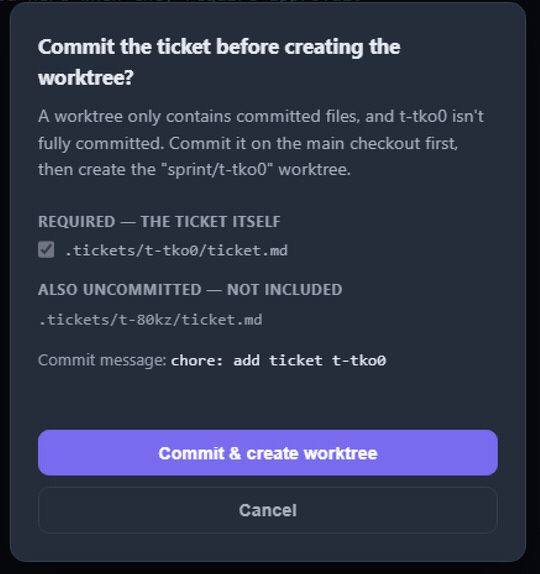
.featurefiles, which a criterion can point to under the ticket, only render on the board and reach CI if they are committed with the ticket. - A worktree only carries committed files. Choose a new worktree for a ticket whose folder is not committed and the board warns you with a red note, and + New offers to commit it first; see Working in worktrees.
If you started from a template that gitignores .tickets/, remove that line so your agent's plans and specs travel with the repo.
Do not commit the runtime files
canon also writes a few per-machine files under .tickets/ that change every session:
.tickets/ACTIVE, the active-sprint pointer..tickets/<id>/.cockpit-cwd,.cockpit-agentand.cockpit-session-id, which the Cockpit writes for a ticket's session.
tkt seeds a .tickets/.gitignore covering them, with the two lines .cockpit-* and ACTIVE. It does this when it sets up the tickets folder and the file is absent, and never overwrites a .gitignore you already have. Commit that file, so the ticket docs are committed and the runtime churn is ignored.
If your repository already committed any runtime files, from before the .gitignore existed, untrack them once. They stay on disk and only stop being versioned:
git rm -r --cached --ignore-unmatch '.tickets/**/.cockpit-*' '.tickets/ACTIVE'
git commit -m "stop tracking canon runtime files"The session log is optional
Each ticket can also hold a cockpit-sessions.md, a one-line log of where each session ran, for example "2026-10-03: sprint start used main checkout". It is not covered by the seeded .gitignore. canon's notes on the worktree dialog above call it optional: "session logs like cockpit-sessions.md are optional", while the ticket's own docs are required. Commit it if you want the history, and leave it untracked if you do not. Either way works.